
When the Twelve Steps were created in the 1930s, the founders didn’t know as much about the disease of alcoholism as we do today. But they understood how alcoholism feels and how it destroys lives. They also found a way to help people recover that has worked for almost 90 years.
Back then, alcoholics experienced powerlessness over their addiction no different that we do today. Alcohol remains unchanged, so has the human body, and alcoholism continues to be the chronic, progressive, and deadly disease it was then.
In Chapter 4 of the Big Book (p. 45), the main text of Alcoholics Anonymous, it says: “Lack of power, that was our dilemma. We had to find a power by which we could live, and it had to be a Power greater than ourselves. Obviously. But where and how were we to find this Power?”
Here, capital-P “Power” is introduced, to be followed shortly by “God.” But powerlessness is real. Almost every recovering alcoholic, including me, has felt it. Our experience of alcoholism hasn’t changed, but our understanding of power has.
In Twelve Step recovery, the concept of power carries a meaning that is drawn from the Big Book. That power is God, and it urges “may you find Him now”. So, when power is discussed in recovery, this assumption is frequently understood and reproduced.
So, let’s dive into a modern view of power and see how it can change our perspective on the Twelve Steps and recovery in AA.
Three Kinds of Power
Starhawk, a scholar and author, has suggested three kinds of power:
- Power-over: This type of power involves control over people, places, and things. It often shows up as someone having authority or being in charge, telling others what to do.
- Power-with: Power-with is the strength and support we get from our relationships, shared goals, and working together. It’s about helping each other out, sticking together, and being part of a team.
- Power-from-within: This type of power comes from inside ourselves—our beliefs, creativity, and strength. It’s about knowing ourselves, believing in ourselves, and being able to handle things even when they’re tough.
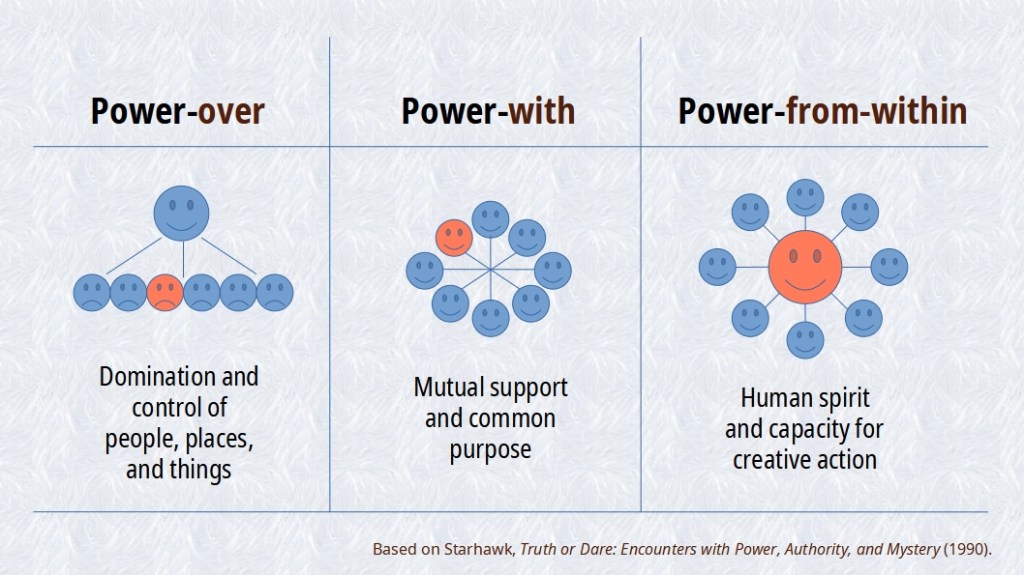
Now, let’s see how these different kinds of power relate to The Twelve Steps.
When we acknowledge our powerlessness over alcohol, we’re admitting that alcohol controls us. That’s the power-over in action.
Next, when we begin to believe in a power greater than ourselves, it might be viewed as a Higher Power. For those of us in secular recovery, it could be the power-with we find in our support groups. Or it could be a set of our cherished values or a way of life we always aspired to but never achieved while drinking.
So when we decide to entrust our lives to this power, we discover power-from-within. We find the strength within ourselves to make positive changes in our lives. We solve the dilemma of “lack of power”.
Meeting the issue of power directly in the Secular Twelve Steps
A commonly used version of the secular Twelve Steps says:
Step One, just like the original: We admitted we were powerless over alcohol—that our lives had become unmanageable.
Step Two: Came to accept and to understand that we needed strengths beyond our awareness and resources to restore us to sanity.
Step Three: Made a decision to turn our will and our lives over to the care of the A.A. program.
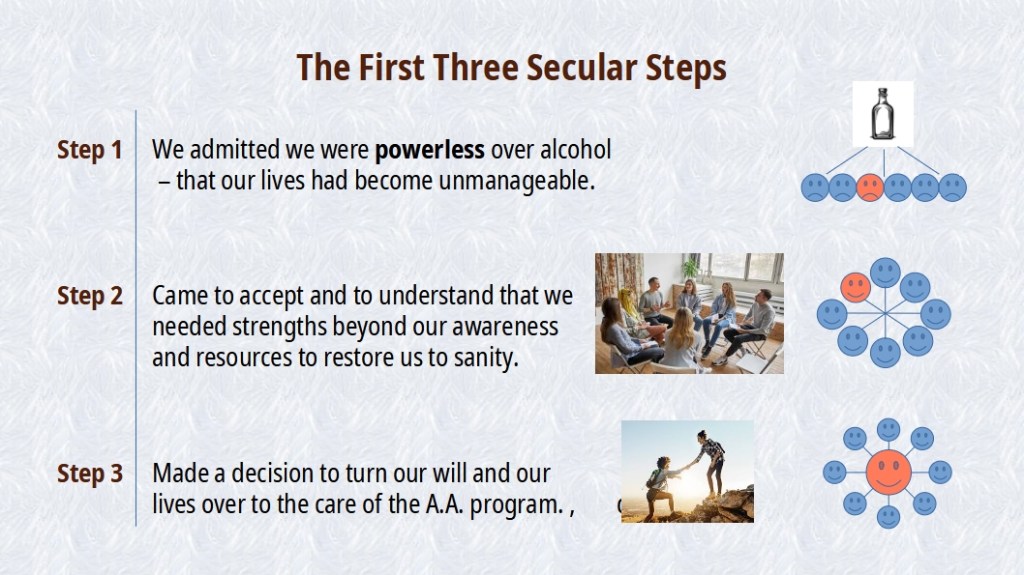
As you can see, ‘power’ is not addressed explicitly here. Step One talks about powerlessness, but the next steps don’t address power at all. I think this is a problem that comes from trying to ‘secularize’ the Twelve Steps—instead of leaning into the question of powerlessness and power, just skip it and move on.
To fill this gap, we can incorporate Starhawk’s understanding of power. Instead of skipping over the notion of power, we can frame it in terms of “power-with” and “power-from-within.” For instance, in secular Step Two, we can understand “strengths beyond our awareness and resources” as the collective power and mutual support of the group (power-with). Similarly, secular Step Three can be viewed as embracing the guidance and support of the A.A. program, fostering a sense of inner strength and community support.
These three kinds of power make Twelve Step recovery more inclusive by focusing on secular ways to solve powerlessness and regain the power to recover. Those who rely on a God of their understanding have their own path to these three kinds of power. Power-with comes from their Higher Power, reflected in the group’s collective support and conscience; power-from-within comes from embracing this source of Power and feeling it within their heart through prayer and meditation.
Viewing the Twelve Steps through these three kinds of power, I see more similarities than differences between theistic and secular approaches.
One thing both approaches agree on: there is no hope for recovery unless the alcoholic—be they atheist, agnostic or believer—stops trying to play God.
 The Peace of Wild Things
2 thoughts on “Solving the problem of ‘power’ in the secular steps”