
I believe that addicts who hit bottom and reach out for help have one thing in common: the way they are living runs against their most cherished values. Choices and actions run in opposite directions to what matters most to them. How often do we hear in recovery the story of how an addict has become ‘the person they never thought they would turn into’? A person looks into the mirror and they see a complete stranger look back. This fracture between being and doing, between true self and the broken self, can happen in sobriety as well.
I was over a year clean and sober when I hit a bottom a year ago. I had a choice between packing it in or getting help. I reached out and began working with a new counsellor. It must be challenging to counsel someone who has no idea who they have become. I think my counsellor made a wise decision: to start me working on discovering what values I want to live by. In the process, I found that my most cherished values were not what I expected. I’m so very grateful for this work, because I think my recovery might have sputtered and stalled had I not identified what was most important to me at this point in my life.
I would like to share the exercises I did which aided me in self-discovery. They’re simple and sensible, and it’s up to you how deep a dive you want to take. You get out of it what you put into it. And you can always return to the work and add to it as you wish—it can be an ongoing project.
There are two exercises. First, you work with a list of values and sort them by how important each is to you. The second part, involves a chart called The Matrix, which simplifies the problem of how to live by your most cherished values. I think it’s a brilliant model which anyone can find benefit in using.
Exercise #1: A values checklist
Below are some common values. (They are not ‘the right ones’; merely common ones. And you can add more at the end.) Please read through the list and write a letter next to each value, based on how important it is to you:
V = very important,
Q = quite important, and
N = not so important.
Of course, some values will be more important in one area of life (e.g. parenting) than in another area (e.g. work) – so this is just to get a general sense of the values that tend to matter to you most. You may also find that you have identified many values as very important. If some are more important than others, one way to rank them is V1, V2, V3, etc.. Doing so will make Exercise #2 a little easier to approach.
One important thing to remember before getting started is to approach these values keeping in mind who you want to be rather than who you have been or which values you were raised with. Ask yourself, “Which values represent my best self?”.
1. Acceptance/self-acceptance: to be accepting of myself, others, life, etc.
2. Adventure: to be adventurous; to actively explore novel or stimulating experiences
3. Assertiveness: to respectfully stand up for my rights and request what I want
4. Authenticity: to be authentic, genuine, and real; to be true to myself
5. Caring/self-care: to be caring toward myself, others, the environment, etc.
6. Compassion/self-compassion: to act kindly toward myself and others in pain
7. Connection: to engage fully in whatever I’m doing and be fully present with others
8. Contribution and generosity: to contribute, give, help, assist, or share
9. Cooperation: to be cooperative and collaborative with others
10. Courage: to be courageous or brave; to persist in the face of fear, threat, or difficulty
11. Creativity: to be creative or innovative
12. Curiosity: to be curious, open-minded, and interested; to explore and discover
13. Encouragement: to encourage and reward behaviour that I value in myself or others
14. Engagement: to engage fully in what I am doing
15. Fairness and justice: to be fair and just to myself or others
16. Fitness: to maintain or improve or look after my physical and mental health
17. Flexibility: to adjust and adapt readily to changing circumstances
18. Freedom and independence: to choose how I live and help others do likewise
19. Friendliness: to be friendly, companionable, or agreeable toward others
20. Forgiveness/self-forgiveness: to be forgiving toward myself or others
21. Fun and humour: to be fun-loving; to seek, create, and engage in fun-filled activities
22. Gratitude: to be grateful for and appreciative of myself, others, and life
23. Honesty: to be honest, truthful, and sincere with myself and others
24. Industry: to be industrious, hardworking, and dedicated
25. Intimacy: to open up, reveal, and share myself, emotionally or physically
26. Kindness: to be kind, considerate, nurturing, or caring toward myself or others
27. Love: to act lovingly or affectionately toward myself or others
28. Mindfulness: to be open to, engaged in and curious about the present moment
29. Order: to be orderly and organized
30. Persistence and commitment: to continue resolutely, despite problems or difficulties.
31. Respect/self-respect: to treat myself and others with care and consideration
32. Responsibility: to be responsible and accountable for my actions
33. Safety and protection: to secure, protect, or ensure my own safety or that of others
34. Sensuality and pleasure: to create or enjoy pleasurable and sensual experiences
35. Sexuality: to explore or express my sexuality
36. Skillfulness: to continually practice and improve my skills and apply myself fully
37. Supportiveness: to be supportive, helpful and available to myself or others
38. Trust: to be trustworthy; to be loyal, faithful, sincere, and reliable
39. Other: [any value not appearing above; add as many ‘Other’ items as you need]
[Source credit for this exercise: © Russ Harris 2013 russharris@actmindfully.com.au Adapted from The Confidence Gap: From Fear to Freedom, by Russ Harris, published by Penguin Group. Australia, 2010.]
Exercise #2: The Matrix
The following model was developed in 2009 by Dr. Kevin Polk, a clinical psychologist who writes primarily in the field of Action Commitment Therapy (ACT). There is an abundance of material online that works with The Matrix, and I recommend browsing it if you want to learn more or get some inspiration. There is also a very good YouTube video here that might be more helpful to you than my brief explanation or reading about it online.
First, let’s take a look at the model you will be working with. This is why it’s called The Matrix—it has nothing to do with Neo or Morpheus or red and blue pills; instead, it is a structure within which we work to discover how to live in accordance with our most cherished values:
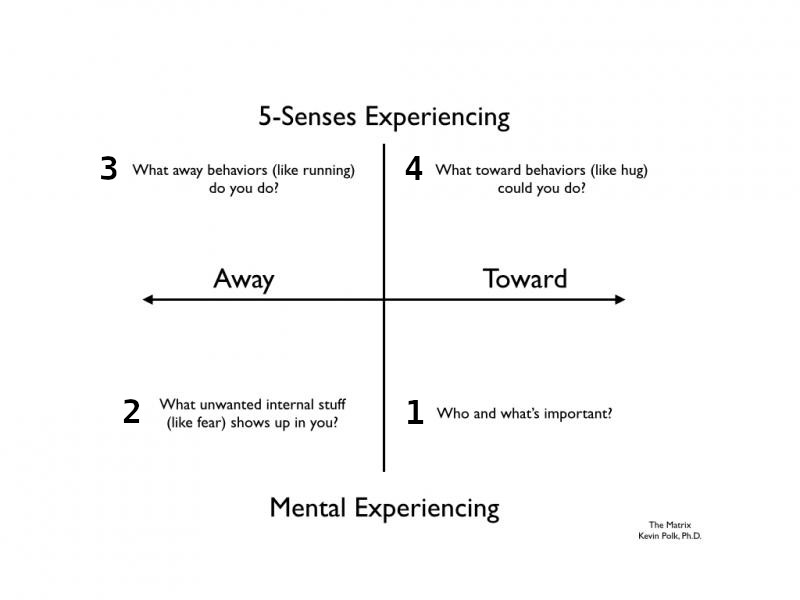
Working with The Matrix is a simple perspective-taking exercise and a tool to help us understand what really matters, how we can move toward what is important, and shed light on what we do to get in our own way of getting there. It might look complex at first, so let’s break it down into its basic elements.
Away/Toward: The horizontal line
Sometimes we need to move away from danger, and at other times we move away from what’s most important to us. Alternatively, we can move toward a goal or an object that will enrich our lives, but we can also reach for a substance that we crave, even though it is poison to us. This is the meaning of this line on the Matrix.
5-Senses Experiencing/Mental Experiencing: The vertical line
The top half is the world of objects and senses and outer experience—smelling a rose, petting a cat, tasting our favourite food, etc. This is our ‘outer world’, observable by others.
The bottom half is our inner world, the realm of thoughts and feelings, desires and fears—our private universe of experience. It is unobservable by others—they can only see the effects, for example, our laughter, tears, movement, and actions.
Now we can look at the four quadrants that the two intersecting lines create. Approach them in the order in which they follow below, from 1 to 4 on the above diagram.
Quadrant #1: The most important values
This is the inner world you want to move toward to live your best life.
This space ties directly into the work done in Exercise #1. Pick a few of your most cherished values from the previous exercise and write them into this quadrant. You can include as many or as few as you wish—it really depends on how focused you want to be. If you work with, for example, 5 or 6 ‘very important’ values, it’s a manageable number to do a lot of introspection and writing on. You can always return and add more later.
Quadrant #2: Inner obstacles
This is the inner experience that draws you away from living your best life.
Write down in this space the thoughts, feelings, urges, and bodily sensations that get in the way of acting towards each of your ‘very important’ value. We’re talking mostly (ego) defences and fears, both conscious and subconscious. Do this part by working with one value at a time. This is your private experience and others cannot help you with this—it’s an inside job! It might also be emotionally challenging work to do, so if you’re not in the right mental or emotional state to write on this you can put it down and pick it up again later. Take as much time as needed—this is not a race around the Matrix!
Quadrant #3: Coping actions
In this space, write down how you cope when you have the thoughts, feelings, urges and bodily sensations listed in Quadrant #2. Do you eat, distract yourself by watching TV or logging onto a video game, withdraw, or perhaps look for a mood altering substance? Because we are now above the horizontal line and in the realm of the observable, you might get clues from how others react to your behaviour. These are the things we do that move us away from uncomfortable thoughts and emotions, but at the same time these actions move us away from our values, from where our best selves want us to be.
Quadrant #4: Small acts that move us toward our values
Write down here the actions that you want to take which are in alignment with your values. This is where the solutions will grow, but it’s important to remember to take ‘baby steps’– this is why small acts should be the focus. You might well be working with a new set of values here, so you might find it exciting to come up with actions and new behaviours that steer you towards them. This quadrant is the birthplace and the nursery of your future best life. It’s going to be a long process. But as you put into practice these small acts on a daily basis, you will start to experience moving away from thoughts, emotions, and sensations that block you and move towards living your values. Also, keep in mind that in addition to being a long process, it’s also not a straight line. Some days bring setbacks and other days a leap forward—it’s a journey and not a destination. The key is to not give up trying to move toward your best life, account for the strides your make at the end of each day, and let go of the rest.
Summary
Working with The Matrix this past spring brought me quite a few a-ha! moments, surprises that rattled long-held beliefs I had of myself and what is important to me. I also discovered that, due to active addiction, I have spent many years stuck in a weird feedback loop between quadrants #2 and #3, while the quadrant #4 rarely appeared on my radar!
I also found that this exercise gave me a ‘north star’ at a time in my life when I had no idea who I was anymore or what I was to live for. For me, at least, it’s been one of the most simple yet powerful tools for change I’ve come across in my lifetime.
 The Peace of Wild Things
One thought on “Moving toward values”